Got it. Here’s the German translation of the text you provided:
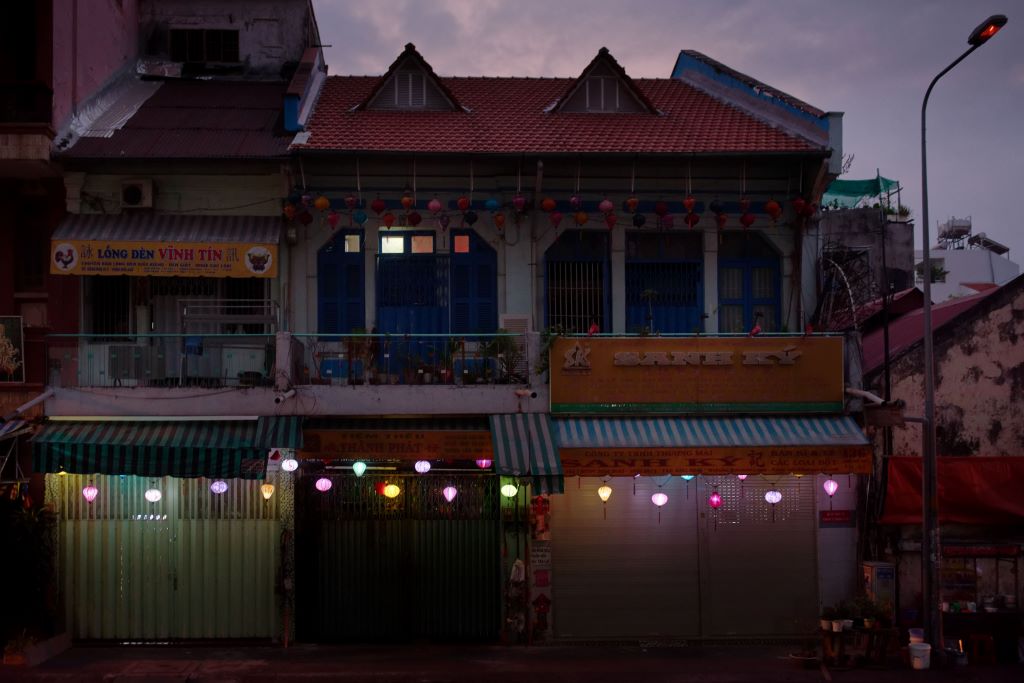
Die Trần Hưng Đạo Straße in Cholon ist ein belebtes Handelszentrum, bekannt für ihre lebhaften Straßenmärkte, vielfältigen Geschäfte und zahlreichen Restaurants. Sie ist die längste Zufahrtsstraße und die Hauptverkehrsader von Ho-Chi-Minh-Stadt, durchquert zahlreiche Stadtteile und erstreckt sich über etwa 6 Kilometer. Ihre Geschichte ist eng mit der Entwicklung der Stadt selbst verknüpft.
Ursprünglich existierten Saigon und Cholon als separate Entitäten.
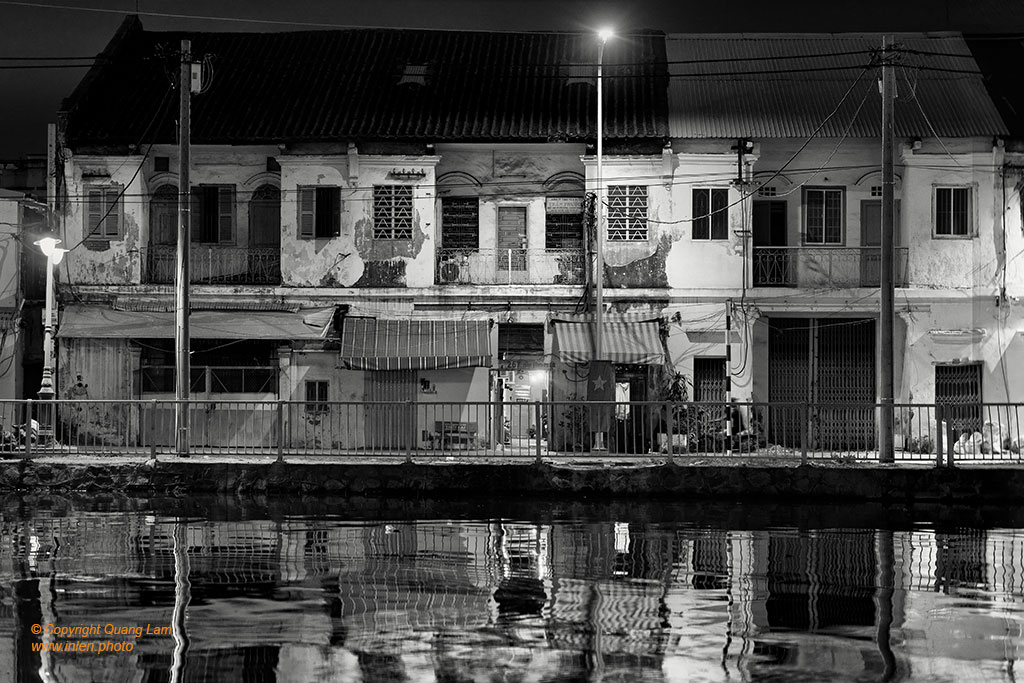
GalleryThis exceptional series comes from the archives of the Inlen gallery. It stands out for its night shots, showcasing a brightly lit Saigon, then considered the “Pearl of Asia.” In addition to iconic landmarks like the Governor’s Palace, the Cathedral, and Ben Thanh Market, the photographer also captured lively spots such as the Rex and Thanh Chung cinemas, Brodard bakery, and the Dong Khanh hotel in the bustling Cholon district. This suggests that Saigon wasn’t just about official monuments,
[…]
GalleryStatement by the visual artist Quang Lam
“The Autograph Collection Hotels, in collaboration with Vinpearl Landmark 81, has launched the visionary project “Gallery in the Sky.” I would like to cultivate the values of international connections and exchanges, leveraging the unique setting of Vinpearl Landmark 81. My vision for “Gallery in the Sky” involves capturing captivating photographs of airplanes arriving from all corners of the globe, visible from the hotel. But invisible, they are like “Air Flows”.
[…]
GalleryThe historical aftermath of the Qing Dynasty’s overthrow of the Ming Dynasty in 17th-century China led to Ming loyalists seeking refuge in Southeast Asia. In Vietnam, these Chinese immigrants played a pioneering role during the “March to the South.” They settled in Bien Hoa. By the late 18th century, to escape the massacres perpetrated by Tay-son troops, the community regrouped in the present-day location of Cholon, situated 11 kilometers away from the center of Saigon,
[…]
GalleryFernand Nadal, born in Algeria, arrived in Saigon in the 1920s. His first advertisement in the magazine Indochine française (1922) described his activities as follows: “Art Photographie—Photography for business” and “Publishing: postcards, photo albums, and documentaries on Cochinchina, Cambodia, and Annam.”
Unlike other studios that focused primarily on portraits, Nadal’s work provided a documentary perspective of that era. He published over 2000 photos, with notable albums including:
- Ruines d’Angkor: A collection of photographs showcasing the ancient temples of Angkor.
[…]
GalleryThe Independence Palace, completed in 1966 by the architect Ngô Viết Thụ, winner of the Prix de Rome, was never inhabited by President Ngo Dinh Diem who requested its construction but by the next President who made him assassinated. It has become a museum since April 30, 1975 when tanks have crashed through its gates.
Renamed as Reunification Palace, It is now the gathering place for all the city’s major festivities and commemorations.
[…]
GalleryThe Saigon’s historic main street goes from the Cathedral to the river. Its name changed three times following Saigon’s history, known as Rue Catinat, then Tu Do (Freedom) and now Dong Khoi (Total Revolution).
Consulates, prestigious companies, wealthy families business set their offices and apartments on that street where to be seen was the must.
213 Dong Khoi St. Block at the corner of Le Thanh Ton St was built in 1930s by Brossard et Mopin,
[…]
GalleryPhotography is about questioning of what reality is and what is captured by the camera.
It is nowadays stimulated by the concept of « hyper-reality » defined by J. Beaudrillard.
It is the inability of consciousness to distinguish reality from a simulation of reality.
This is particularly relevant nowadays where people accept created environments as primarily models, when they are actually all fake.
Video mapping can express the dissolution of the reality into a form that have any reference to the initial architecture.
[…]
GalleryThis scene is part of the work on the series “Escape” talking about migration.
The theme of the psychological maze is explored through patterns of doors (Thy Nguyen Truong Minh Installation), corridors, rooms, and stairs in old buildings of Saigon.
[…]
GalleryReunification – this is the same aspiration for all people who shared the same history whose destiny has diverged suddenly. The fate of the Vietnamese contemporary history can be read through the different names given to this place: Governor’s Palace, Independence Palace, and Reunification Palace.